


How iBUS Eliminated Mobile Dead Zones Across 40+ Departments at PMCH.
HealthcarePatna Medical College & Hospital (PMCH), one of Asia's largest public hospitals, was losing mobile signal across wards, diagnostic zones, and basements; disrupting staff coordination and blocking OTP-based access to schemes like Ayushman Bharat and ABHA.
With no architectural drawings available and patient care unable to pause, iBUS Networks engineered a fibre-fed, multi-operator Neutral Host Distributed Antenna System (DAS) - shared indoor antennas that rebroadcast multiple carriers' signal throughout the building.
The result: 500+ antennas installed across 40+ departments ensuring consistent signal restored in every dead zone. The entire deployment completed without a single drill hole or disruption to hospital operations.
At a Glance
| Location | Patna, Bihar, India |
|---|---|
| Facility Type | Government public hospital: PMCH - spanning wards, diagnostics, OPDs, basements |
| Solution | Multi-operator Neutral Host DAS on a fibre-fed backbone, installed non-invasively |
| Coverage Improvement | Persistent dead zones - consistent signal strength hospital-wide |
| Key Impact | Uninterrupted patient care, reliable staff coordination, dependable access to Ayushman Bharat and ABHA |
The Challenge
PMCH had to undergo a major infrastructure upgrade since persistent mobile connectivity gaps were identified across critical zones; including patient wards/diagnostic areas/basement levels. In a 100-year-old (yet active) hospital environment, these dead zones disrupted day-to-day operations - from routine staff coordination to OTP-based verification required for government healthcare schemes such as Ayushman Bharat and ABHA.
The deployment environment also carried significant constraints of its own:
- No structural documentation: no drawings or cable routes existed. The building had to be manually mapped before design work could begin.
- Deep indoor signal RF attenuation: basements, stairwells, and lower floors saw consistent signal loss.
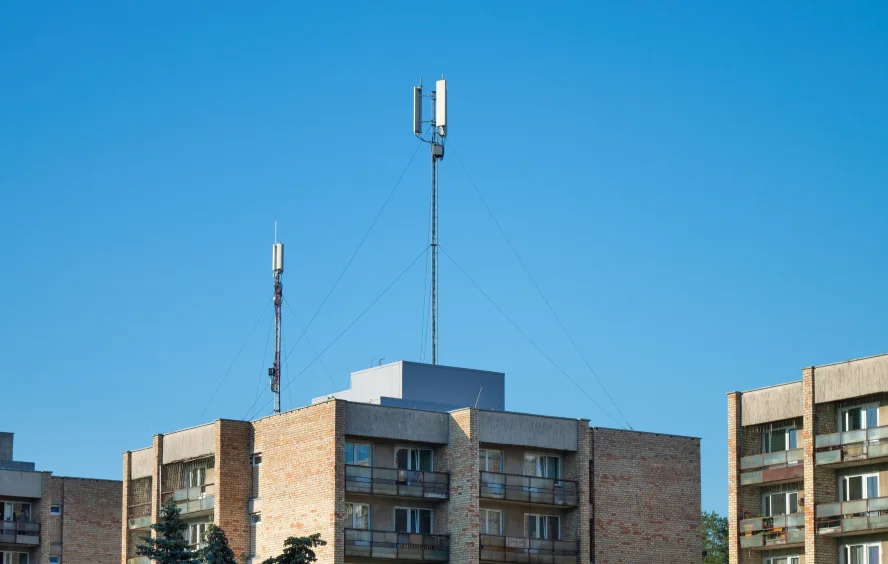
- Weak incoming signal capture: limited rooftop space restricted equipment placement for pulling in outdoor carrier signal.
- Zero tolerance for disruption: continuous patient activity ruled out drilling or cutting through walls and floors.
- Blocked digital health workflows: poor connectivity disrupted OTP verification, digital payments, and mobile-first diagnostic and admin processes.
The Solution
iBUS Networks designed and deployed a hybrid, fibre-fed, multi-operator Neutral Host DAS for shared network infrastructure for simultaneous multi-operators use. The approach was built specifically for an active, structurally undocumented healthcare facility, combining RF survey-led planning, entirely non-invasive installation methods, and multi-band infrastructure ready for both LTE and 5G, to deliver consistent indoor coverage across 40+ hospital departments without pausing hospital operations at any point.
How It Was Built
- Manual signal mapping: With no architectural drawings available, the team conducted walkthroughs and shaft mapping across 40+ departments, using RF planning software (iBwave) to design the network around the building's actual layout.
- Antenna deployment: More than 500 indoor antennas were installed across OPDs, wards, diagnostics, stairwells, and corridors, fed by a hybrid fibre network with multi-band support.
- Non-invasive installation: Fibre and coax cabling were manually routed using surface-mounted routes, eliminating any need for drilling or core-cutting in sensitive hospital areas.
- Signal fine-tuning: Directional donor antennas and signal amplifiers (BBUs) were positioned to maintain clean, stable reception despite limited rooftop space.
- Testing and optimization: Walk tests using industry-standard tools (TEMS and Nemo) fine-tuned signal strength and antenna positioning, with all work scheduled during non-peak, silent hours to avoid disrupting patients and staff.
- Handover: The network was integrated with operator systems under the neutral host model, with real-time monitoring dashboards and hands-on training handed over to the facility team.
Results: Before and After
| Parameter | Before | After |
|---|---|---|
| Indoor Signal Coverage | Dead zones in basements, stairwells, lower floors | Consistent signal across all zones |
| Healthcare Scheme Access | OTP verification frequently disrupted | Reliable access to Ayushman Bharat, ABHA, payments |
| Structural Impact | N/A - no indoor network | Zero drilling or structural modification |
| Operational Disruption | High risk given live operations | Zero disruption throughout deployment |
| Network Readiness | Legacy, single-band | LTE-enabled, 5G-ready, neutral host across 4 bands |
| Deployment Scale | No structured indoor network | 500+ antennas across 40+ departments |
Technical Outcomes
- 500+ indoor antennas deployed across 40+ hospital departments, including OPDs, wards, diagnostics, stairwells, and corridors.
- Consistent signal strength achieved in every previously low-coverage zone, including basements and lower floors.
- Fully LTE-enabled and 5G-ready infrastructure, operating as a neutral host across four mobile bands.
- Entire deployment completed with zero drilling, core-cutting, or structural modification anywhere on site.
- Real-time signal monitoring dashboards handed over, with facility teams trained for ongoing, proactive network management.
Institutional Benefits
- Uninterrupted Patient Care: The entire deployment was completed without disrupting hospital services or requiring structural modifications, protecting continuity of care throughout a live, fully operational hospital.
- Staff Coordination: Clinical and administrative teams across the hospital reported improved mobile communication, supporting mobile-first workflows for diagnostics, labs, and administration.
- Cost Efficiency & Scalability: The neutral host model allows multiple operators to share one infrastructure footprint, reducing long-term maintenance complexity and cost compared to operator-by-operator deployments.
- Replicable Model: The project established a scalable, precision-led deployment approach that can be replicated across other high-density, structurally undocumented healthcare facilities.
Patient Access in Focus: Digital Healthcare Scheme Verification
OTP-based verification for government healthcare schemes like Ayushman Bharat and ABHA depends on a stable mobile connection to authenticate patients and process claims in real. Before this deployment, patchy indoor coverage across wards and diagnostic areas put this access at risk on a regular basis. With consistent signal now restored hospital-wide, patients and visitors can reliably complete OTP-based verification for these schemes alongside digital payments, making essential healthcare access a routine part of a patient's visit rather than something dependent on where in the building they happen to be standing.
Related Case Studies

August 26, 2026
Multi-Operator Neutral Host IBS/DAS Architecture for High-Density University Campus

August 6, 2026
How iBUS Connected 280 Offices at Lotus Corporate Park with an ISP-Neutral FTTX Network

August 6, 2026
How iBUS Achieved 99% Call Success Inside a 100-Year-Old Government Landmark

August 6, 2026
How iBUS Delivered Full Indoor Mobile Coverage and 165 Mbps at Karnataka High Court.
August 4, 2026
How iBUS delivered 100% network coverage with Managed Wi-Fi and GPON fibre solutions for a premier healthcare retreat