

Why Digital Connectivity Matters Inside Healthcare Environments
January 19, 2026
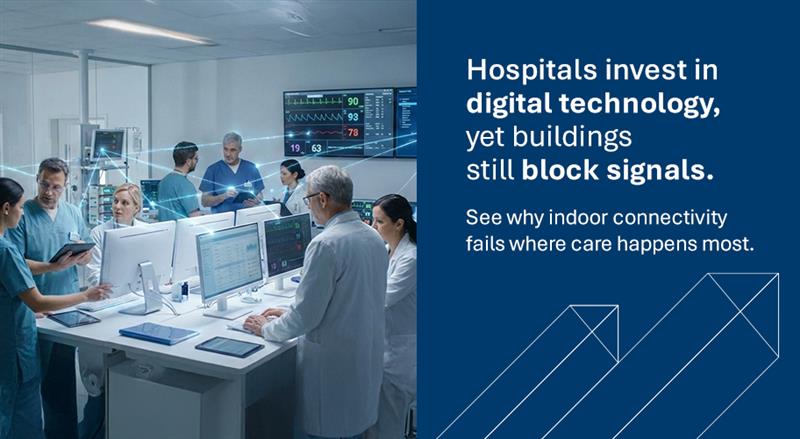
Hospitals today operate as high-density, always-on environments where care delivery depends on uninterrupted connectivity. Clinical teams, medical devices, patients, and visiting families all rely on mobile networks and Wi-Fi to stay connected throughout the day.
Modern healthcare facilities are no longer used only by doctors and nurses. Patients are accompanied by family members who spend long hours inside hospitals. From waiting areas and wards to diagnostics and recovery zones, reliable device connectivity has become part of the overall care experience.
Yet while medical technology and hospital infrastructure have advanced rapidly, indoor digital connectivity inside many healthcare facilities has not kept pace. This gap creates operational blind spots that affect response time, coordination, and the experience of everyone inside the building.
The Reality Inside a Modern Hospital
A hospital is not a single workspace. It is a complex, vertical environment that includes ICUs, operating theatres, emergency rooms, diagnostic labs, basements, isolation wards, waiting areas, and public zones.
Across these spaces, hospitals depend on device connectivity through mobile signals and Wi-Fi for:
- • Doctor and nurse voice communication
- • Alerts from patient monitoring systems
- • Nurse call systems and emergency codes
- • Coordination between the emergency, radiology, ICU, and pharmacy teams
- • Access control, surveillance, and security systems
- • Connectivity for patients and families using personal devices
- • Building systems that support power, ventilation, and life safety
Industry data shows that modern hospitals run 10 to 15 connected devices per bed, including patient monitors, infusion pumps, telemetry systems, and mobile clinical devices. At the same time, hospitals support thousands of personal devices used by patients, attendants, and visitors each day.
This makes healthcare one of the most demanding indoor connectivity environments.
Where Connectivity Breaks Down in Hospitals
Despite this dependence, indoor connectivity remains inconsistent across many healthcare facilities.
Common problem areas include:
- • ICUs and operating theatres, where shielding and medical-grade construction weaken signals
- • Basements and parking levels, where outdoor networks do not reach
- • Elevators and stairwells, where calls and data sessions drop during movement
- • High-density wards and waiting areas, where congestion affects performance
- • Sealed diagnostic rooms, including MRI and radiology zones
These issues exist because outdoor telecom networks are not designed for indoor healthcare environments. Thick walls, lead-lined rooms, steel-heavy structures, and signal-blocking materials prevent reliable penetration.
Wi-Fi supports data access, but hospitals also require uninterrupted voice mobility, multi-operator coverage, and networks that remain stable during emergencies and peak activity. Both mobile signals and Wi-Fi play distinct roles, and neither can replace the other.
In healthcare, this is not just an inconvenience.
- • A missed call can delay clinical response
- • A dropped alert can slow intervention
- • A connectivity gap can disrupt coordination during emergencies
- • Poor connectivity adds stress for patients and families during long hospital stays
Why DAS Is Critical in Healthcare Facilities
Distributed Antenna Systems address the limitations of outdoor networks by extending mobile coverage throughout the building, zone by zone.
In healthcare environments, DAS enables:
- • Reliable voice communication across all floors and departments
- • Stable delivery of alerts from patient monitoring and nurse call systems
- • Continuous connectivity as staff move between zones
- • Multi-operator coverage so doctors, staff, patients, and visitors stay connected
- • Performance stability during peak usage and emergency situations
DAS ensures that mobility works where healthcare happens, not just in select areas.
For hospitals, this supports faster response times, better coordination, and a more reliable experience for everyone inside the facility.
How iBUS Supports Digital Connectivity in Healthcare
iBUS designs and deploys in-building mobility infrastructure tailored for complex healthcare environments.
Our approach focuses on:
- • Seamless 4G and 5G coverage across clinical, diagnostic, and public zones
- • Signal planning that accounts for shielding, basements, elevators, and high-risk areas
- • Neutral-host DAS that supports multiple operators
- • End-to-end deployment, monitoring, and optimisation
By addressing connectivity at the infrastructure level, iBUS helps healthcare facilities reduce blind spots, maintain continuity, and support both clinical operations and everyday connectivity needs.
Connectivity Is Now Part of Care Delivery
In healthcare environments, digital connectivity supports more than technology systems. It shapes how care teams coordinate, how patients stay informed, and how families remain connected during critical moments.
Hospitals that treat device connectivity across mobile signals and Wi-Fi as core building infrastructure are better prepared to support modern care delivery.
That shift is already underway.
Related Posts

November 20, 2025
TRAI Calls Out India’s Indoor Connectivity Blind Spot, Here’s How We Are Addressing It.

May 27, 2025
You have planned the classrooms, the courtyards, the curriculum. But what about the bandwidth?